Family Notes - March 2006
This is a sample of the information provided to members of the P*rr*tt Society in the March 2006 edition of Family Notes. Family Notes is a 56-page printed magazine that is distributed to society members every quarter.

FAMILY HISTORY ON THE INTERNET
The web site of the Commonwealth War Graves Commission has been described as one of the most user friendly sites for family historians to use. Its other great virtue is that it is full of data of use to us, particularly (though not exclusively) through its ‘Debt of Honour Register’. And, in passing its has a third virtue - it is free!
Back to basics - what is the Commonwealth War Graves Commission? (I’ll call it CWGC from now on). I quote from the site:
‘The Commission was established by Royal Charter in 1917. Its duties are to mark and maintain the graves of the members of the forces of the Commonwealth who were killed in the 2 World Wars, to build memorials to those who have no known grave and to keep registers and records and registers, including after the 2nd world war, a record of the civilian war dead. 1,700,000 men and women of the Commonwealth forces died in the 2 World Wars. Of these the remains of 925,000 were found and their graves marked with a headstone. Where the remains were not found, the casualty’s name is commemorated on a memorial. There are war graves in some 150 different countries, mostly in the 2,500 war cemeteries and plots constructed by the Commission.’
Before moving on to the material available to researchers I should mention that the records are only for those who died in the 2 World Wars. This was brought home to me a couple of years ago when I went to visit the graves of 2 RAF trainee pilots who were killed in San Marcos, Texas, in early 1953. The graves turned out to be in poor condition, unlike the pristine stones in the CWGC European cemeteries. I made enquiries of the CWGC who pointed out that casualties outside the dates of the 2 wars were theresponsibilty of a department of the Army. Subsequently I contacted the department. Surprisingly it had no record of these deaths but immediately made arrangements for their upkeep. But, of course, these casualties do not feature in the records which can be searched on the CWGC web site.
If you are looking for details of someone killed in the wars (and this includes civilians in the 2nd World War) your point of entry into the web site is at www.cwgc.org/cwgcinternet/search.aspx.
There you will find a simple form which will bring results even if you only type in minimal information. To test this I typed in a surname SIDEBOTHAM and nothing else. Straight away the screen showed details of 26 people of that name. The form allows only one Christian name initial, so if your relative was known by a name other than his first name, ensure that the correct initial is entered.
 So, in summary, typically you
will find Rank, initials, surname, forenames if known, unit, regiment, service
number if known, age if known, date of death, grave or memorial reference and
the name of the cemetery or memorial. In addition you may find details of the
casualty’s next of kin, as in the 2 examples below. Those without names of next
of kin are because because not all the ‘Final Verification’ forms sent to the
last known address of the casualty’s next of kin were returned. Clearly though
where these details are given this is important genealogical information and
where it was not previously known it now enables the family tree to go back
another generation.
So, in summary, typically you
will find Rank, initials, surname, forenames if known, unit, regiment, service
number if known, age if known, date of death, grave or memorial reference and
the name of the cemetery or memorial. In addition you may find details of the
casualty’s next of kin, as in the 2 examples below. Those without names of next
of kin are because because not all the ‘Final Verification’ forms sent to the
last known address of the casualty’s next of kin were returned. Clearly though
where these details are given this is important genealogical information and
where it was not previously known it now enables the family tree to go back
another generation.
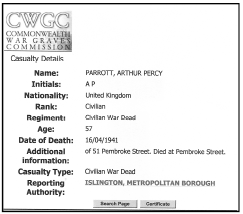
The ability to trace civilians killed by enemy action is another feature of the site which can be invaluable to family historians. A check of the index came up with Arthur Percy Parrott who died in Islington. Clicking on his name brought up the casualty details page (above). So here we have a date of death, an age and an address. Local newspapers might well have further details in the form of death notices, though wartime censorship would probably have prevented full accounts of the air raid which brought about the death.
If the details found on the web site encourage you to visit the cemetery this is made easier because the CWGC gives clear instructions on how to find it, and gives a grave number to enable the exact spot to be found. Many, many casualties were never found and the CWGC erected monuments with the names of the missing engraved upon them. If this is the case the individual ‘casualty details’ page indicates this fact. The monuments themselves can be imposing and moving; though not to have had to erect them in the first place would have been a happier situation. This site has to be the most important single site to visit when seeking ancestors killed in the World Wars. A ‘certificate’ to each death can be accessed by clicking the ‘certificate’ button on the ‘casualty details’ page.
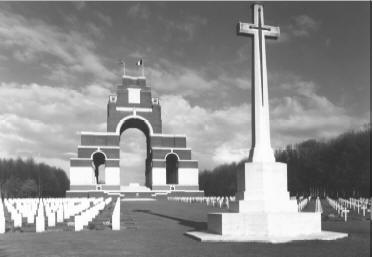
The cemetery and memorial at Thiepval, Somme, France. The
stones (left) are British burials; the crosses (right) are French. The memorial
has engraved upon it the names of 72,107 soldiers who were missing, believed
killed, in the area.
 A
P*RR*TT PHOTO GALLERY
A
P*RR*TT PHOTO GALLERY
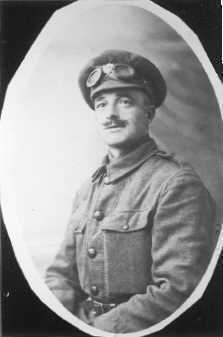 |
In this picture, dating from the First World War we see George John Perrett, blacksmith, and husband of Annie (nee Hall) and grandfather of Pamela Molesworth (member 864) who kindly provided the photograph. He was born in 1883. George and his wife were both from Great Barrington, Gloucestershire and they married in Cheltenham in 1912. The uniform he is wearing is clearly that of a driver or motorcyclist and has the look of the army about it; but the badges and buttons cannot be seen clearly. So it might have been that of a chauffeur or civilian motorcylist such as an AA patrol. Any suggestions? |
| This is George Porrett, born Newcastle upon Tyne in 1854, tobacconist and mason. He belongs on the family tree of Geri Porrett (867) and both are related to Turner Porrett and Eleanor Carr of Scarborough and Newcastle upon Tyne, married in 1806. (My thanks to Geri for the photograph) Descendants of this couple settled in the USA and normally hold a family reunion on the last Sunday in July at St Clair City, MI. Further details of this family and its various branches have been assembled and are available for all to see on the Internet on the following web site: http://familytreemaker.genealogy.com/users/w/e/e/Tom-Weeks/ | 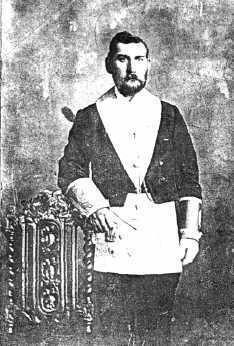 |

The Wiltshire Family History Society have researched all the P*rr*tts appearing in their county's Quarter Sessions, 1722-1820, and not only that have also sorted them into "Goodies" and Baddies".
To start we'll list just those "Baddy" Perretts who misbehaved and landed in Devizes Gaol:
8 Oct 1778 Joseph of Seend
15 July 1800 Henry of Erlestoke
12 Jan 1768 Joseph of North Bradley
15 Jan 1793 Richard of W Lavington
15 Jul 1794 Thomas of West Bradley
12 Jan 1808 Thomas (25) - - -
13 Jul 1819 William (19) of Erlestoke
11 Apr 1820 William of M Lavington
11 Jul 1820 William of Salisbury
12 Apr 1763 William of Marston
12 Jul 1763 William of Marston NB: The Richard of 1793 and William of 1763 were
referred to the County Assizes for judgement.
Now for the "Baddy" Perrotts:
8 Oct 1767 John of Bishops Canning
12 Apr 1774 Mary of Erlestoke
These went to the county gaol:
15 Jul1771 John Perrott of Imber
8 Oct 1771 John Perrott - - - -
15 Jan 1772 John Perrott - - - -
1 Apr 1788 Henry Parrott of Milford
NB: John of Imber was actually sentenced to death but was reprieved and
transported to Virginia (see Family Notes Vol 1l, page 243)
We'll get round to the few "Goodies" in a later Journal.